Buy revolvers.eu ?
We are moving the project
revolvers.eu .
Are you interested in purchasing the domain
revolvers.eu ?
domain@kv-gmbh.de · 0541-91531010
Buy revolvers.eu ?
What are Japanese honorific suffixes?
Japanese honorific suffixes are used to show respect and politeness when addressing or referring to others. They are attached to the end of a person's name or title, and the choice of suffix depends on the person's social status, age, and relationship to the speaker. Common honorific suffixes include -san (used for both men and women in formal and informal situations), -sama (used to show utmost respect, often for customers or people of higher status), and -chan (used for endearment, often for children, close friends, or pets). Honorific suffixes are an important aspect of Japanese language and culture, reflecting the emphasis on social hierarchy and respect. **
What is the Japanese honorific with "cchi"?
The Japanese honorific with "cchi" is typically used to show familiarity or affection towards someone. It is often added to a person's name or nickname to express closeness or intimacy. This honorific is commonly used among friends, family members, or people who have a close relationship with each other. **


Similar search terms for Honorific
Top-Angebote
Products related to Honorific:
-
"""Ammunition Cabernet Sauvignon 2022 Red Wine - California""""""Dark garnet velvet in color and texture, this Cabernet from Paso Robles highlights what the region is quickly being known for, those delicious Bordeaux grapes. Featuring rich dark fruits with notes of black cherry, blueberry, and spice, this..."20,97 $*Shipping: 0,00 $Secure redirect to the provider



-
What is the Japanese honorific for brother?
The Japanese honorific for brother is "お兄さん" (onii-san) when addressing an older brother and "弟" (otouto) when addressing a younger brother. These honorifics are used to show respect and politeness when referring to one's brother in Japanese. **
-
What is the Japanese honorific for an older brother?
The Japanese honorific for an older brother is "onii-san" (お兄さん) or "onii-chan" (お兄ちゃん) when speaking in a more familiar or affectionate tone. These honorifics are used to show respect and affection towards an older brother in Japanese culture. **
-
How do I receive the English honorific title Sir and be elevated to knighthood?
To receive the English honorific title Sir and be elevated to knighthood, one must be nominated for the honor by someone else. Typically, individuals are nominated for their significant contributions to society, such as in the fields of charity, public service, or the arts. The nomination process involves a thorough review by the government and ultimately approval by the Queen. Once approved, the individual will participate in a ceremony where they will be dubbed a knight and receive the title Sir. **
-
How can a shooting club exist without its own firearm?
A shooting club can exist without its own firearm by allowing members to bring their own firearms to use during club activities. The club can also partner with local shooting ranges or firearm retailers to provide access to firearms for club members. Additionally, the club can organize group firearm rentals for its members to use during events and competitions. By utilizing these methods, a shooting club can still provide a space for members to practice and compete in shooting sports without needing to own its own firearms. **

What is the correct grammar for metal toy revolvers?
The correct grammar for metal toy revolvers is to use the plural form "metal toy revolvers" when referring to more than one of them. When referring to just one, use the singular form "metal toy revolver." Additionally, when using the possessive form, add an apostrophe and an "s" after the word "revolver" to indicate ownership, such as "the metal toy revolver's trigger." **
Is a pistol crossbow as powerful as a real pistol?
No, a pistol crossbow is not as powerful as a real pistol. While a pistol crossbow can still be dangerous and cause harm, it typically has a lower velocity and stopping power compared to a real pistol. Real pistols are designed to fire bullets at high speeds and are more lethal than a pistol crossbow. **
Top-Angebote
Products related to Honorific:
-
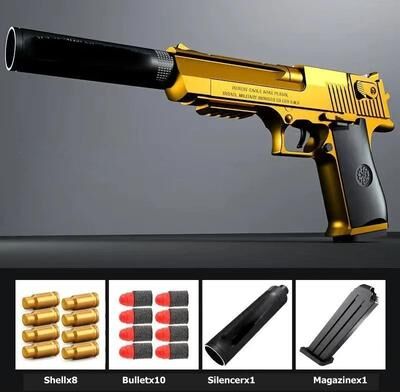
Uplifted Finds Desert Eagle Shell Ejection Toy Pistol With Soft Foam Bullets For Outdoor CS Shooting Games cExperience the thrill of tactical play with this Powerful Desert Eagle Toy Gun, designed for realistic action and safe fun. This Airsoft Pistol alternative features an authentic Shell Ejection mechanism that mimics a real firearm, popping out a...72,97 $*Shipping: 0,00 $Secure redirect to the provider
-
"""Ammunition Cabernet Sauvignon 2022 Red Wine - California""""""Dark garnet velvet in color and texture, this Cabernet from Paso Robles highlights what the region is quickly being known for, those delicious Bordeaux grapes. Featuring rich dark fruits with notes of black cherry, blueberry, and spice, this..."20,97 $*Shipping: 0,00 $Secure redirect to the provider
-
What are Japanese honorific suffixes?
Japanese honorific suffixes are used to show respect and politeness when addressing or referring to others. They are attached to the end of a person's name or title, and the choice of suffix depends on the person's social status, age, and relationship to the speaker. Common honorific suffixes include -san (used for both men and women in formal and informal situations), -sama (used to show utmost respect, often for customers or people of higher status), and -chan (used for endearment, often for children, close friends, or pets). Honorific suffixes are an important aspect of Japanese language and culture, reflecting the emphasis on social hierarchy and respect. **
-
What is the Japanese honorific with "cchi"?
The Japanese honorific with "cchi" is typically used to show familiarity or affection towards someone. It is often added to a person's name or nickname to express closeness or intimacy. This honorific is commonly used among friends, family members, or people who have a close relationship with each other. **
-
What is the Japanese honorific for brother?
The Japanese honorific for brother is "お兄さん" (onii-san) when addressing an older brother and "弟" (otouto) when addressing a younger brother. These honorifics are used to show respect and politeness when referring to one's brother in Japanese. **
-
What is the Japanese honorific for an older brother?
The Japanese honorific for an older brother is "onii-san" (お兄さん) or "onii-chan" (お兄ちゃん) when speaking in a more familiar or affectionate tone. These honorifics are used to show respect and affection towards an older brother in Japanese culture. **
Similar search terms for Honorific
-
Uplifted Finds Desert Eagle Shell Ejection Toy Pistol With Soft Foam Bullets For Outdoor CS Shooting Games aExperience the thrill of tactical play with this Powerful Desert Eagle Toy Gun, designed for realistic action and safe fun. This Airsoft Pistol alternative features an authentic Shell Ejection mechanism that mimics a real firearm, popping out a...72,97 $*Shipping: 0,00 $Secure redirect to the provider
-
Uplifted Finds Desert Eagle Shell Ejection Toy Pistol With Soft Foam Bullets For Outdoor CS Shooting Games bExperience the thrill of tactical play with this Powerful Desert Eagle Toy Gun, designed for realistic action and safe fun. This Airsoft Pistol alternative features an authentic Shell Ejection mechanism that mimics a real firearm, popping out a...92,97 $*Shipping: 0,00 $Secure redirect to the provider
-
How do I receive the English honorific title Sir and be elevated to knighthood?
To receive the English honorific title Sir and be elevated to knighthood, one must be nominated for the honor by someone else. Typically, individuals are nominated for their significant contributions to society, such as in the fields of charity, public service, or the arts. The nomination process involves a thorough review by the government and ultimately approval by the Queen. Once approved, the individual will participate in a ceremony where they will be dubbed a knight and receive the title Sir. **
-
How can a shooting club exist without its own firearm?
A shooting club can exist without its own firearm by allowing members to bring their own firearms to use during club activities. The club can also partner with local shooting ranges or firearm retailers to provide access to firearms for club members. Additionally, the club can organize group firearm rentals for its members to use during events and competitions. By utilizing these methods, a shooting club can still provide a space for members to practice and compete in shooting sports without needing to own its own firearms. **
-
What is the correct grammar for metal toy revolvers?
The correct grammar for metal toy revolvers is to use the plural form "metal toy revolvers" when referring to more than one of them. When referring to just one, use the singular form "metal toy revolver." Additionally, when using the possessive form, add an apostrophe and an "s" after the word "revolver" to indicate ownership, such as "the metal toy revolver's trigger." **
-
Is a pistol crossbow as powerful as a real pistol?
No, a pistol crossbow is not as powerful as a real pistol. While a pistol crossbow can still be dangerous and cause harm, it typically has a lower velocity and stopping power compared to a real pistol. Real pistols are designed to fire bullets at high speeds and are more lethal than a pistol crossbow. **
* All prices are inclusive of VAT and, if applicable, plus shipping costs. The offer information is based on the details provided by the respective shop and is updated through automated processes. Real-time updates do not occur, so deviations can occur in individual cases. ** Note: Parts of this content were created by AI.